STUCKFIX
handymanDIY Friendly
floor

Squeaky Floorboards Under Carpet? Stop Them Without Ripping Up the Rug

That creak in the hallway drives you nuts at 2 AM. You don't need to tear up the carpet to fix it — here's the surgical approach.

Category:Flooring
Difficulty:Moderate
Time:15-30 min
Success:85%
Updated:May 17, 2026

quick_referenceQuick Answer

For Squeaky Floorboards Under Carpet? Stop Them Without Ripping Up the Rug, start with "Find the Exact Squeak Spot — The Talcum Powder Trick": Have someone walk slowly across the carpet while you lie next to them, ear to the floor. Mark the squeak zone with painter's tape — be precise to within 2 inches. Now sprinkle talcum powder or cornstarch along the joist line in that area. The powder falls through the carpet fibers and lubricates the wood-on-wood contact. If the squeak drops by 50%, you know it's a board-edge rub, not a nail pop. Stop DIY if floor is sagging visibly — may indicate structural joist damage, not just loose boards. This is listed as a moderate recovery and usually takes about 15-30 min.

verifiedGuide Snapshot

Repair areaFlooring
Estimated time15-30 min
DifficultyModerate
Stop conditions2

Last updated May 17, 2026. Review the stop conditions before continuing.

help1. Understand the Problem

The squeak is wood rubbing against wood — a loose subfloor nail or a floorboard that's lifted 1/16 inch from the joist below. When you step on it, the wood flexes and rubs against the nail shaft or adjacent board.

build_circle2. Try This First
Best First Step
Find the Exact Squeak Spot — The Talcum Powder Trick

Find the Exact Squeak Spot — The Talcum Powder Trick

Have someone walk slowly across the carpet while you lie next to them, ear to the floor. Mark the squeak zone with painter's tape — be precise to within 2 inches. Now sprinkle talcum powder or cornstarch along the joist line in that area. The powder falls through the carpet fibers and lubricates the wood-on-wood contact. If the squeak drops by 50%, you know it's a board-edge rub, not a nail pop.

visibility3. Visual Guidance

See what's happening and how to try the first recovery step.
1
Step 1: Locate the Floor Joist
Locate the Floor JoistUse a stud finder with deep-scan mode on the squeaky area. Mark the joist edges with tape through the carpet. If no stud finder, use the 'knock test' — knock along the floor with your knuckle. The pitch changes from hollow (between joists) to solid (over a joist). Joists in most homes are 16 inches on-center.
2
Step 2: Drive a Breakaway Screw Through the Carpet
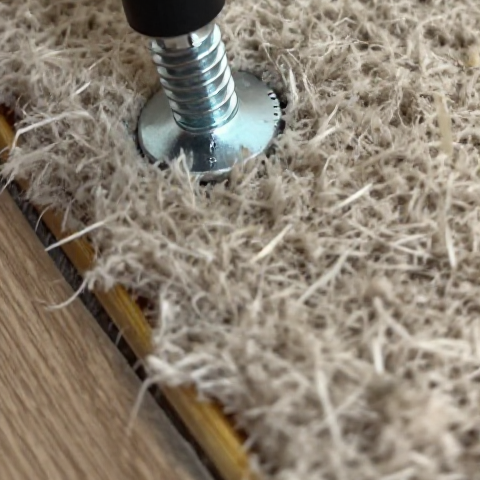
Drive a Breakaway Screw Through the CarpetBuy a Squeeeeek No More kit or similar breakaway screw kit at Home Depot ($20). It includes a tripod jig, spacer, and special scored screws. Position the jig over the joist line, drill the scored screw through the carpet and into the floorboard/joist below. The screw has a notched shank that snaps off 1/8 inch below the carpet surface — no visible hole, no damage to carpet fibers. The screw head pulls the loose board tight to the joist.
3
Step 2b: If Between Joists — Add Blocking from Below
Step 2b: If Between Joists — Add Blocking from BelowIf the squeak is between joists (board-to-board rubbing at the tongue-and-groove), and you have access from a basement ceiling or crawlspace, apply construction adhesive (PL Premium) into the gap between the subfloor and the joist from below. Then wedge a 2x4 scrap block tightly between the joists, pressed against the squeaky subfloor section. Screw through the block into the joists. The upward pressure silences the rub.

autorenew4. If That Doesn't Work

Try the next recovery options.

card_giftcard
Baby Powder + Credit CardWork talcum powder into the carpet at the squeak line with an old credit card. Temporary but free.
chevron_right
carpenter
Pull Carpet and Re-screw SubfloorIf the squeak is widespread (entire hallway), bite the bullet. Pull back the carpet from the nearest wall, screw down every subfloor board with #8 x 2-inch deck screws every 6 inches on the joists, then re-stretch the carpet.
chevron_right

Frequently Asked Questions

Will the breakaway screw damage my carpet?expand_more
No — the screw is designed with a small diameter head and a scored breakaway point. The carpet fibers part around it and spring back after the screw head snaps off below the surface. The hole is invisible. Thousands of carpeted homes are fixed this way every year.
Can I just use regular wood screws from above?expand_more
Never. A regular screw driven through carpet will snag and unravel carpet fibers, leaving a permanent tufted divot. Breakaway screws are specially designed for through-carpet installation — use the right tool for the job.
Is it better to fix from above or below?expand_more
If you have unfinished basement or crawlspace access, fixing from below is always better — you see exactly what's loose and can glue + screw the subfloor properly. No carpet puncture at all. From above (breakaway screws) is for second-floor rooms with finished ceilings below.

warning5. Stop DIY If

Don't continue if any of these apply.

reportFloor is sagging visibly — may indicate structural joist damage, not just loose boards
reportSqueak is accompanied by a spongy feel — possible water damage or rot
Still stuck?Get personalized help with AI Recovery.

Related Recovery Problems

View all arrow_forward

This page provides general DIY guidance.
If you're unsure, it's always best to consult a professional.